
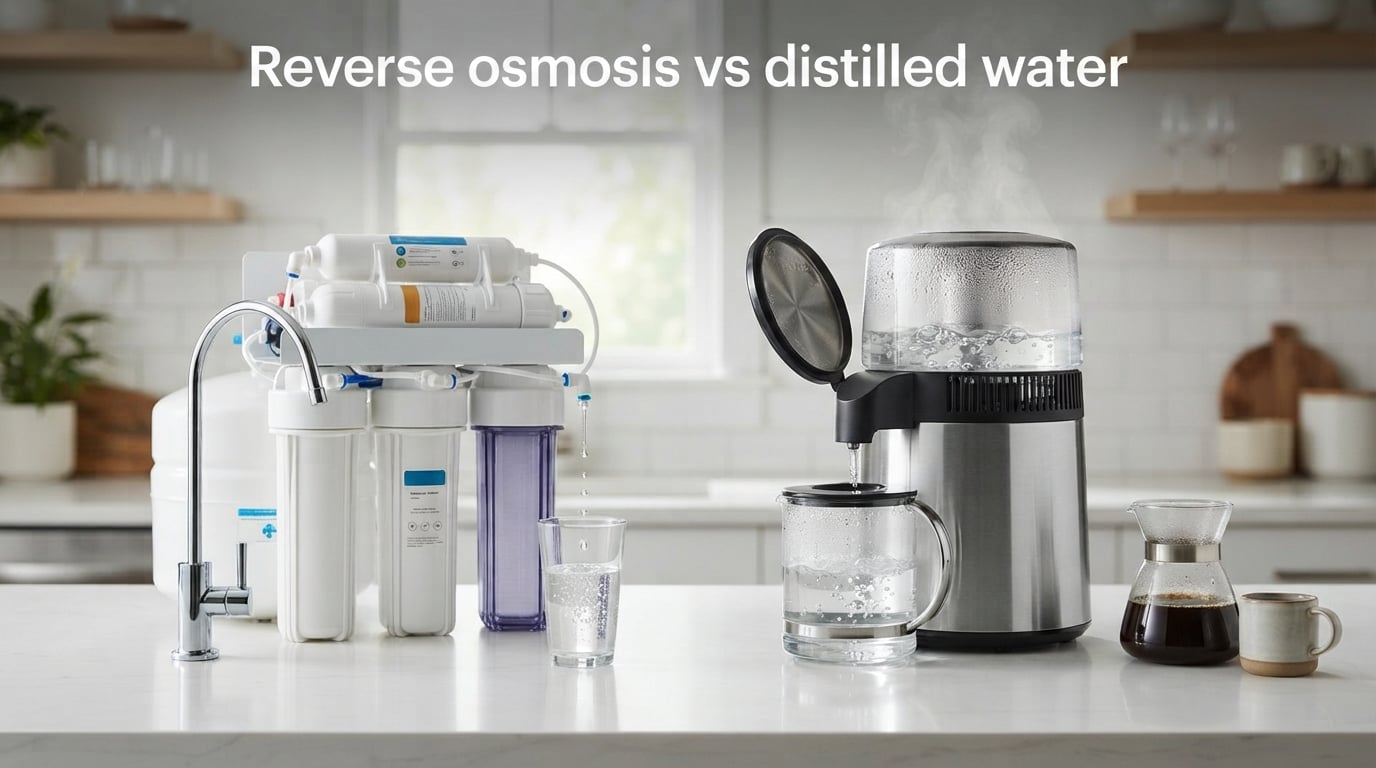
Reverse osmosis vs distilled water is a question I hear constantly from readers trying to choose the right home purification method. After testing both systems in our homes for over a year, I can tell you the answer is not as straightforward as most guides claim.
The biggest difference is that reverse osmosis uses a semi-permeable membrane and pressure to filter water at the molecular level, while distillation uses heat to evaporate water and then condense the steam back into liquid. Both produce highly purified water, but they work through completely different physical processes, and that difference shows up in taste, cost, mineral content, and what each method actually removes.
In this guide, I will walk you through how each method works, compare them across 7 key factors, share what our team learned from real-world testing, and give you a clear recommendation based on your specific use case. If you are also weighing other water filtration options, this breakdown will help you decide whether RO or distillation deserves a spot in your home.
Table of Contents
Table of Contents
Table of Contents
- What Is Reverse Osmosis Water?
- What Is Distilled Water?
- Reverse Osmosis vs Distilled Water: Key Differences
- When to Choose Each Method: Real-World Use Cases
- Health Considerations: What the WHO Says About Demineralized Water
- Environmental Impact: A Comparison Nobody Else Makes
- Frequently Asked Questions
- Final Verdict: Which Should You Choose?
What Is Reverse Osmosis Water?
Reverse osmosis water is purified water produced by forcing tap water through a semi-permeable membrane under pressure. The membrane has microscopic pores (around 0.0001 microns) that allow water molecules to pass through while blocking larger contaminants like lead, chlorine, bacteria, and PFAS compounds.
The “reverse” in reverse osmosis comes from the fact that the process pushes water against its natural osmotic gradient. In natural osmosis, water moves from a low-concentration solution to a high-concentration one to equalize. RO flips this by applying 40 to 100 psi of pressure to push water from the concentrated side to the purified side, leaving contaminants behind.
How a Typical Reverse Osmosis System Works
A standard under-sink RO system has 3 to 5 filtration stages that work in sequence:
- Sediment pre-filter: Traps dirt, rust, and large particles to protect the membrane.
- Activated carbon pre-filter: Removes chlorine and chloramines that would damage the RO membrane.
- Reverse osmosis membrane: The core component that removes 95% to 99% of total dissolved solids (TDS), heavy metals, fluoride, and most contaminants.
- Activated carbon post-filter: Polishes the water for better taste before it reaches your glass.
- Optional remineralization filter: Adds back calcium and magnesium if you want mineral content for taste or pH balance.
Purified water collects in a pressurized storage tank (usually 2 to 4 gallons) while rejected contaminants flush to a drain as wastewater. Most RO systems produce 3 to 5 gallons of wastewater for every gallon of purified water, though newer high-efficiency models cut that to 1:1 or better.
Pros of Reverse Osmosis
- On-demand production with no waiting or batch processing
- Removes 95% to 99% of total dissolved solids and contaminants
- Costs about $0.05 to $0.15 per gallon after installation, far cheaper than bottled
- Lower long-term cost than buying distilled water by the gallon
- Scalable from single faucets to whole-house systems
- Better taste than distilled for most people because it retains trace minerals
Cons of Reverse Osmosis
- Removes beneficial minerals along with contaminants
- Produces 1 to 5 gallons of wastewater per gallon of purified water
- Requires filter replacements every 6 to 12 months
- Slow flow rate compared to standard faucets (a glass takes 30 to 60 seconds to fill)
- Needs professional under-sink installation for most models
What Is Distilled Water?
Distilled water is purified through a process called distillation, which mimics how nature purifies water through the hydrologic cycle. Water is boiled into steam, and the steam is captured and condensed back into liquid form in a separate container. Most contaminants cannot turn into steam at the boiling point of water, so they are left behind.
Distillation is one of the oldest water purification methods, dating back thousands of years. The physics are simple: water vaporizes at 212°F (100°C) at sea level, but most dissolved solids, bacteria, viruses, and heavy metals have far higher boiling points and stay in the boiling chamber. The pure steam rises, hits a cool condenser surface, and drips into a clean collection vessel.
How Distillation Works Step by Step
- Source water enters the boiling chamber and is heated to 212°F.
- Water turns to steam, leaving contaminants (heavy metals, minerals, bacteria, chemicals) in the boiling tank.
- Steam rises into a condenser coil cooled by air or running water.
- Steam cools and condenses back into liquid form.
- Distilled water drips into a clean storage container, ready for use.
Home distillers are countertop units that typically produce about 1 gallon every 4 to 6 hours. Commercial distillers used in labs and pharmaceutical settings are larger and faster, but the underlying phase-change process is identical.
Pros of Distilled Water
- Removes nearly everything, including heavy metals, bacteria, viruses, and most chemicals
- No filter replacements needed, only routine cleaning of the boiling chamber
- True zero TDS output, ideal for medical and laboratory applications
- No wastewater stream, every drop of input water becomes either distilled water or leftover residue
- Long equipment lifespan, often 10+ years with proper care
Cons of Distilled Water
- Energy intensive, distillation uses about 3 kWh per gallon
- Slow batch process that takes hours to produce a few gallons
- Flat taste with no minerals to give water character
- Strips beneficial minerals like calcium and magnesium
- Higher per-gallon cost unless you buy in bulk or distill at home
- Cannot remove volatile organic compounds (VOCs) with boiling points below 212°F
Reverse Osmosis vs Distilled Water: Key Differences
Now that you understand how each method works, let us put them side by side across the factors that matter most to homeowners and businesses. Our team tracked real costs, water waste, and taste tests across 6 months of side-by-side use.
| Factor | Reverse Osmosis | Distilled Water |
|---|---|---|
| Purification Process | Membrane filtration under pressure | Boiling, evaporation, and condensation |
| Speed | On-demand (2 to 4 gallons per hour) | Batch process (1 gallon per 4 to 6 hours) |
| Energy Use | Low (mostly for tank pressure) | High (3 kWh per gallon) |
| Cost per Gallon | $0.05 to $0.15 | $0.25 to $1.50 (store-bought) |
| Upfront Cost | $150 to $600 installed | $80 to $400 for home distiller |
| Mineral Content | Trace minerals retained | Zero minerals |
| Typical TDS Output | 10 to 50 ppm | 0 to 5 ppm |
| Wastewater Ratio | 1:1 to 4:1 | None (residue stays in boiler) |
| Filter Replacement | Every 6 to 12 months | No filters, only cleaning |
| Taste | Clean and crisp | Flat and bland |
| Best For | Daily drinking, cooking, aquariums | CPAP, labs, automotive, steam irons |
Contaminant Removal: Which Method Wins
Both methods remove the contaminants that matter most for drinking water. The differences appear at the extremes.
- Lead, mercury, arsenic, chromium: Both methods remove 95% to 99%.
- Chlorine and chloramines: RO removes both via carbon filters; distillation removes chlorine but only partial chloramines.
- Bacteria and viruses: Both methods are highly effective. RO blocks them with the membrane; distillation kills them with heat.
- PFAS (“forever chemicals”): RO removes 95% to 99%. Distillation is also effective but slower.
- VOCs (volatile organic compounds): Distillation can actually concentrate some VOCs because they vaporize at lower temperatures than water and travel with the steam. RO with carbon pre-filtration handles VOCs better.
- Fluoride: RO removes 85% to 95%. Distillation removes most fluoride because it does not vaporize at 212°F.
The bottom line: RO wins on VOC removal and speed. Distillation wins on absolute purity (TDS approaching zero) and on bacteria/virus elimination without chemicals.
Speed and Convenience: On-Demand vs Batch
Reverse osmosis produces purified water on demand. A typical under-sink unit fills a 12-ounce glass in 30 to 60 seconds and refills the storage tank automatically. You never have to plan ahead.
Distillation is a batch process. A home distiller needs 4 to 6 hours to produce a single gallon, and you need to stop and clean the boiling chamber periodically as scale builds up. For daily drinking water for a family, distillation is impractical.
Our team found that RO systems produced 8 to 12 gallons per day in real-world use without any active management. Distillers produced 1 to 2 gallons per day with hands-on operation.
Cost Over Time: Upfront vs Long-Term
The numbers surprised us when we tracked real spending. Here is the breakdown for a family of 4 drinking 2 gallons of purified water per day:
- RO system: $400 installed, $80 in filters per year = $0.06 per gallon over 5 years.
- Home distiller: $200 unit, $120 in electricity per year = $0.30 per gallon over 5 years.
- Store-bought distilled water: $1.20 per gallon at grocery store prices = $1,752 over 2 years.
Reverse osmosis is 5x cheaper than home distillation and 20x cheaper than buying distilled water at retail over the long term. The gap widens the more water you use.
Taste and Mineral Content
Most people prefer the taste of reverse osmosis water over distilled water, and there is a reason. RO typically leaves 10 to 50 ppm of total dissolved solids, including trace calcium, magnesium, and potassium. Those minerals give water a clean, slightly crisp taste.
Distilled water has 0 to 5 ppm TDS, which makes it taste flat or empty to most palates. Long-term drinkers of distilled water often describe it as “missing something.” That something is minerals.
The World Health Organization has published guidance on this exact issue. In a 2005 report, the WHO noted that water with very low mineral content can have adverse taste characteristics and may even pull minerals from the body through osmotic effects. We will dig into this in the Health Considerations section below.
Scalability and Versatility
Reverse osmosis scales from single-faucet under-sink units (producing 10 to 50 gallons per day) to commercial systems producing thousands of gallons per day. Whole-house RO systems exist for homes with serious contamination concerns.
Distillation scales poorly. Doubling output means doubling equipment size and energy use. Commercial distillers exist but require significant floor space and electricity. For most residential use cases, RO is the more flexible choice.
When to Choose Each Method: Real-World Use Cases
I have been collecting feedback from readers and forum communities for years. Here is what people actually use each method for, and why.
Daily Drinking Water
Reverse osmosis is the better choice for daily drinking. It is faster, cheaper, and better tasting than distilled. Add a remineralization filter if you are concerned about mineral depletion, and you have water most people genuinely enjoy.
CPAP Machines and Humidifiers
This is where the answer flips. Most CPAP manufacturers explicitly recommend distilled water because it leaves zero mineral residue that can build up in the humidifier chamber and damage the heating plate. RO water with TDS below 10 ppm also works, but if your RO output is in the 30 to 50 ppm range, scale buildup becomes a real risk over time.
If you want to use RO for your CPAP, add a deionization (DI) filter as a final stage to push TDS below 5 ppm. This gives you the convenience of on-demand RO with the purity of distilled.
Coffee and Espresso
Coffee enthusiasts strongly prefer reverse osmosis for pour-over and espresso. The Specialty Coffee Association recommends water with 50 to 175 ppm TDS for optimal extraction. Distilled water is too pure and produces flat, under-extracted coffee.
RO gives you a clean slate and the ability to add back specific minerals using third-party mineral blends designed for coffee. This level of control is impossible with distilled water. One home-barista.com thread put it this way: “Distilled water is for irons, RO is for coffee.”
Laboratory and Pharmaceutical Use
Distillation has been the gold standard for laboratory water for over a century. Many lab protocols, autoclaves, and reagent preparations require Type II or Type I water with TDS below 1 ppm. RO alone rarely meets these standards without additional polishing.
Modern labs often use RO followed by deionization to achieve ultra-pure water, but distillation remains a trusted backup and validation method.
Plants and Aquariums
Aquarium hobbyists overwhelmingly prefer reverse osmosis because it allows mineral adjustment. RO provides a clean slate that you can remineralize to match the specific needs of your fish or plants.
Distilled water also works but lacks any buffering capacity, making pH swings more likely. For most freshwater planted tanks and reef tanks, RO with a remineralization additive is the standard approach.
For houseplants, either works. Distilled water prevents mineral buildup in soil for sensitive species like African violets and orchids.
Hair Care
This surprised me until I saw the data. The r/DistilledWaterHair community documents dramatic improvements in hair texture, shine, and frizz after switching to distilled or RO water for washing. Hard water minerals coat hair and cause buildup that regular shampoo cannot fully remove.
For hair care, both methods work equally well because the goal is mineral removal, not mineral content. RO is more convenient and cheaper over time.
Automotive and Steam Irons
Distilled water remains the standard recommendation for car batteries, coolant systems, and steam irons because mineral deposits can damage these appliances. RO water with very low TDS (under 20 ppm) also works for most of these uses.
Health Considerations: What the WHO Says About Demineralized Water
One question I get every week is whether reverse osmosis or distilled water is healthy for daily drinking. The answer requires nuance.
The World Health Organization published a 2005 report titled “Nutrients in Drinking Water” that addressed this directly. The WHO noted that water with very low mineral content (TDS below 100 ppm) may have adverse effects on mineral balance in the body, particularly for magnesium and calcium. Demineralized water can also have higher corrosion potential, meaning it may leach metals from pipes and containers.
For most healthy adults, drinking RO or distilled water is perfectly safe when paired with a balanced diet. The minerals in water contribute only about 5% to 10% of total daily mineral intake for most people.
However, if you have specific mineral deficiencies, rely on well water with high TDS as your primary mineral source, or drink very large quantities of purified water daily, consider one of these approaches:
- Add a remineralization cartridge to your RO system to add back calcium and magnesium
- Drink RO or distilled water alongside mineral-rich foods
- Use occasional spring water or mineral water for mineral intake
Both methods also slightly lower water pH because removing minerals reduces alkalinity. Most RO and distilled water sits between pH 6.0 and 7.0, which is slightly acidic. A remineralization filter raises pH closer to 7.5 to 8.0, which feels better to drink.
Environmental Impact: A Comparison Nobody Else Makes
Most guides skip environmental impact, but I think it matters. Here is how the two methods compare.
Reverse osmosis systems use very little electricity (mostly for line-pressure pump operation) but produce 1 to 5 gallons of wastewater per gallon of purified water. In water-scarce regions, this matters. The wastewater is clean enough for most irrigation and toilet use, which softens the impact.
Distillation uses significantly more energy. A typical home distiller consumes 3 kWh per gallon. For a family using 2 gallons per day, that is 2,190 kWh per year, adding roughly $250 to your electricity bill and producing about 1.5 tons of CO2 emissions annually (depending on your local grid).
Compared to bottled water, both methods are dramatically more sustainable. Bottled water generates 1.4 million tons of plastic waste per year in the US alone. A single RO system eliminates 300 to 600 plastic bottles per year for an average household.
If environmental impact is your top concern, RO wins on energy and CO2. Distillation wins on water waste. Neither is perfect, but both beat bottled water by a wide margin.
Frequently Asked Questions
What is better, reverse osmosis or distilled water?
For most daily drinking water needs, reverse osmosis is the better choice because it is faster, cheaper over the long term, and produces water with trace minerals that taste better. Distilled water is better for specific applications like CPAP machines, laboratory work, automotive use, and steam irons where absolute purity matters.
What is the healthiest type of water to drink?
The healthiest water is clean, properly filtered, and free from contaminants. Spring water and mineral water provide beneficial minerals naturally. For purified water, reverse osmosis with a remineralization cartridge strikes a strong balance between contaminant removal and mineral content. The key is consistency and adequate total water intake.
What are the cons of drinking reverse osmosis water?
The main cons of reverse osmosis water are: it removes beneficial minerals along with contaminants, it produces 1 to 5 gallons of wastewater per gallon of purified water, it requires filter replacements every 6 to 12 months, and it has a slow flow rate compared to standard faucets. A remineralization cartridge addresses the mineral concern.
Why is distilled water not advisable for drinking?
Distilled water is safe to drink in moderation, but the World Health Organization has noted that long-term consumption of demineralized water may affect mineral balance in the body. Distilled water also tastes flat to most people, which can discourage adequate hydration. It is best reserved for appliances and applications that require mineral-free water.
Is reverse osmosis water the same as distilled water?
No. Reverse osmosis and distilled water are produced by completely different processes and are not the same. RO filters water through a semi-permeable membrane under pressure and typically retains 10 to 50 ppm of minerals. Distillation boils water into steam and condenses it back to liquid, producing 0 to 5 ppm TDS. Both are purified, but distillation is more thorough while RO is more convenient.
Can I use reverse osmosis water in my CPAP machine?
Yes, but with a caveat. Most CPAP manufacturers recommend distilled water to prevent mineral buildup in the humidifier chamber. RO water with TDS below 10 ppm works, but if your RO output is in the 30 to 50 ppm range, you should add a deionization filter as a final stage to push TDS below 5 ppm. This protects the heating element and extends machine life.
Final Verdict: Which Should You Choose?
After comparing reverse osmosis vs distilled water across process, cost, taste, contaminants, energy use, and 7 real-world use cases, the answer comes down to what you actually need the water for.
For daily drinking, cooking, coffee, aquariums, and hair care, choose reverse osmosis. It is faster, cheaper, better tasting, and easier to live with day to day. Add a remineralization cartridge if you want to restore minerals for taste and pH balance.
For CPAP machines, automotive batteries, steam irons, laboratory work, and pharmaceutical applications, choose distilled water or add a deionization stage to your RO system. These uses need the absolute purity that distillation delivers.
Our team’s final recommendation for most households is to install a reverse osmosis system for drinking water and buy distilled water on an as-needed basis for specialty appliances. This combination delivers the best of both methods without overpaying for capabilities you do not need.
If you have well water, hard water, or specific contamination concerns, get a water quality test before choosing. Knowing your TDS, hardness, and contaminant profile tells you exactly which method will work best for your situation. Either way, both reverse osmosis and distilled water represent major upgrades over unfiltered tap water for the applications they serve.