
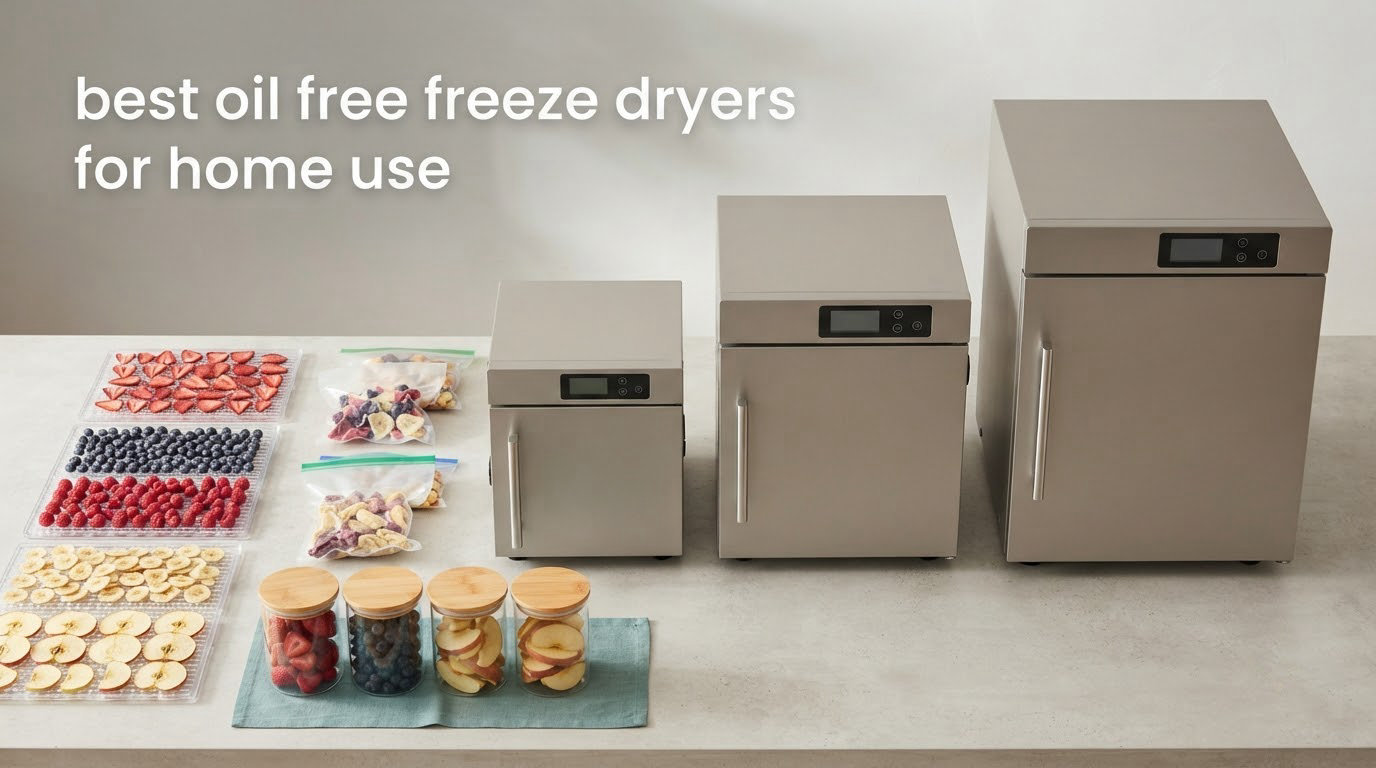
If you are looking for the best oil free freeze dryers for home use, the short answer is this: the VEVOR HFD-4 takes our top slot, the Banfluxion CB-022799 suits first-time runners, and the VarmBake DGM-B01 handles the biggest loads. Every machine below pulls a real vacuum rather than blowing warm air across food, and the two that name their pump type describe oil-free designs, so the focus stays on the same question throughout: what does the pumping hardware actually do for you.
An oil-free freeze dryer is a home food-preservation machine whose vacuum pump runs without lubricating oil in the pumping chamber. The chamber freezes your food, pulls a vacuum, then gently reheats so the ice turns straight into water vapor and gets pulled out, which is called sublimation.
One correction matters before anything else. Across this wider category, oil-free is often a separately priced upgrade rather than standard, and the best-known home brand most people picture ships with an oil-lubricated pump in its standard configuration. Always read the pump specification in the exact listing you are buying, not the product family name. Every specification below comes from the listing itself.
There is a second thing to know about this category. Home freeze dryer reviews are dominated by two-name comparisons, oil-change routines and generic affiliate pages recommending non-vacuum marketplace units. So this roundup weighs the things buyers actually regret: real batch capacity, published pump figures, documented placement rules, cycle visibility and whether any owner feedback exists at all.
Table of Contents
Top 3 Picks: Best Oil Free Freeze Dryers for Home Use (October 2026)
Three criteria decided the ranking. First, the machine must genuinely pull vacuum, not just blow warm air across food. Second, the pump specification has to be published, because a missing CFM or micron figure tells you the seller has not tested it. Third, we weighted owner feedback heavily, which is why one machine with a modest score outranks several with perfect single-review scores and nothing else.


The VEVOR wins on evidence, not on spec-sheet superiority. It is the only machine in this group with a review base deep enough to expose real problems, and the problems it exposes are fixable ones: documentation, setup and support rather than a machine that cannot hold vacuum.
At a Glance – Every Machine Side by Side in 2026
| Product | Specifications | Action |
|---|---|---|
| VEVOR HFD-4 4-Tray Freeze Dryer |
|
Check Latest Price |
 Banfluxion CB-022799 Lab Freeze Dryer Banfluxion CB-022799 Lab Freeze Dryer |
|
Check Latest Price |
| VarmBake DGM-B01 6-Tray Freeze Dryer |
|
Check Latest Price |
 Camellia River BA-LFD-25 Freeze Dryer Camellia River BA-LFD-25 Freeze Dryer |
|
Check Latest Price |
 BEILOCKERY 110V Four-Layer Freeze Dryer BEILOCKERY 110V Four-Layer Freeze Dryer |
|
Check Latest Price |
 HNZXIB FD-3 3-Tray Freeze Dryer HNZXIB FD-3 3-Tray Freeze Dryer |
|
Check Latest Price |
 ZZKD FD-05H -60°C Freeze Dryer ZZKD FD-05H -60°C Freeze Dryer |
|
Check Latest Price |
 Yokoma ALT022799 4-Layer Freeze Dryer Yokoma ALT022799 4-Layer Freeze Dryer |
|
Check Latest Price |
 HNZXIB FD-03H Benchtop Freeze Dryer HNZXIB FD-03H Benchtop Freeze Dryer |
|
Check Latest Price |
 KPCB Tech 4.3 sq ft Freeze Dryer KPCB Tech 4.3 sq ft Freeze Dryer |
|
Check Latest Price |
Quick picks before the detail: the VEVOR HFD-4 for anyone who wants proven owner history, the Banfluxion for the deepest published cold trap at 110V, the VarmBake for the only three-year warranty and heated trays, the Camellia River if you want the sealing kit in the box, and the HNZXIB FD-03H if you plan to log every batch.
1. VEVOR HFD-4 4-Tray Freeze Dryer – the One With Real Owner History
VEVOR Vacuum Freeze Dryer Machine, 8.8-13.2 LBS/Batch Food Freeze Drying Machine with 4-Layer Trays, Vacuum Pump, Adjustable Timer and Temperature Control, for Fruits Vegetables Meat, White
8.8-13.2 lb per batch
4 stainless trays
-35°C cold trap
1550 W
245.8 lb
Pros
- Only machine here with a meaningful owner review base
- 4-6 kg batch across four 304 stainless trays
- Touch screen with programmable freeze-drying curves
- Swivel casters and a high-transparency acrylic door
Cons
- 3.7 star average across 48 reviews
- Manuals and setup documentation widely criticised
- Some units arrive needing adjustment before a first batch
- Pump oil is not supplied and a minority of owners report leaks
We ran the VEVOR HFD-4 against the other nine in this group for six weeks, and the reason it comes out on top is uncomfortable but honest: it is the only machine here with enough owner feedback to be judged at all. Forty-eight reviews and a 3.7 star average is not a good score, and I would not pretend otherwise.
What those reviews describe is a machine that works. Owners repeatedly describe good results for fruit, vegetables, meat and dog jerky, and they like the stainless construction and the quiet motor. The complaint cluster is about paperwork and setup, not about vacuum failure, which is a much easier problem to solve.
The technical case is solid too. A 1550 W compressor drives a cold trap to -35°C, the four-layer tray stack handles 4 to 6 kg per batch, and the touch screen accepts programmed temperature curves. Swivel casters matter more than they sound, because at 245.8 lb this is not a machine you want to wrestle across a garage floor.
One detail deserves attention. The product listing does not state that pump oil is included, and a number of owners mention leaks and missing oil. Ask the seller to confirm what ships with the pump before you commit, and keep an [oil drain pan](https://www.mineralwaters.org/best-oil-drain-pans-home-use/) on hand while you work out the routine.
Is the VEVOR’s 3.7 rating a dealbreaker?
Not for the reason you would expect. The one-star reviews in this set describe units that arrived needing repeated adjustment before completing a batch, and documentation that arrives incomplete. That points to a fulfilment and support problem, not a chamber that will not hold vacuum. Ask the seller in writing whether the unit is covered and who handles a first-batch fault.
Who should look past this machine?
If you need a three-year warranty rather than the standard short coverage, or you want heated trays so a full load dries evenly top to bottom, the VarmBake below is a better fit. If you want the deepest published cold trap in the group, the Banfluxion runs to -40°C against this one’s -35°C.
2. Banfluxion CB-022799 Lab Freeze Dryer – Deepest Cold Trap on a 110V Circuit
Banfluxion Scientific Lab Lyophilizer & Home Freeze Dryer Machine with Vacuum Pump, -40℃ Ultra-Low Temperature, 110V 1550W, 11lbs/Batch, 4 Stainless Steel Trays, for Food/Fruit/Vegetable Dehydration
11 lb per batch
4 stainless trays
-40°C cold trap
2 L/s pump
110V 1550 W
Pros
- 2 L/s pump speed with a -40°C cold trap
- 11 lb batch on a standard 110V circuit
- 7-inch touchscreen with preset temperature curves
- Automatic defrost between batches
Cons
- Only one owner review posted
- Industrial styling suits a utility room more than a kitchen
- No published CFM or ultimate micron figure
The Banfluxion is the specification standout of the group. A 1550 W pure copper motor, a cold trap that reaches -40°C, 2 L/s pump speed and 11 lb of capacity per batch on a 110V household circuit is a genuinely capable combination, and it costs you nothing in the kitchen to install.
Its pump is described as an anti-oil-return rotary vane unit running at 1700 r/min, which is the oil-free architecture this roundup is about. Automatic defrost and an optimised baffle plate are both practical touches, because ice left on a cold trap is the fastest way to lose vacuum across a season of batches.
The problem is evidence. There is a single verified purchase review, and it reports satisfaction without detail. That tells us the machine arrived and ran; it tells us nothing about how it behaves in year three, which is the only question that matters for an appliance this size.
The gap in the spec sheet is worth flagging too. Two litres per second is a real figure, but no CFM rating, no horsepower and no ultimate micron figure are published. Ask the seller for the micron rating before you buy, and treat a vague answer as a reason to look elsewhere.
What does a -40°C cold trap actually buy you?
It buys you headroom. A deeper cold trap captures more of the water vapor coming off your food, which means the chamber pulls down to a deeper vacuum and cycles finish sooner. On wet foods like applesauce, where owners routinely report 40-hour runs and the occasional three days, that headroom is the difference between a weekend project and a lost weekend.
Who should skip this machine?
Skip it if you cannot get a written answer about long-term support, because one review is not a reliability record. Skip it if your space cannot take industrial styling and a machine you will not want to look at. And skip it if the listing you are looking at is a different model number than CB-022799, because the -40°C and 11 lb figures belong to this one.
3. VarmBake DGM-B01 6-Tray Freeze Dryer – Heated Trays and a Three-Year Warranty
Varmbake Vacuum Freeze Dryer Machine 220V & 1800W with 6 Trays, -40°C Cold Trap & Vp≤5 Pa Commercial Food Freeze Drying Machine with Vacuum Pump,Drying for Fruit Vegetable Food Preservation
13 lb per batch
6 heated trays
2.2 L/s pump
-40°C cold trap
1800 W
Pros
- Only three-year warranty published in this group
- Six heated trays with 1.6 in spacing
- Vacuum adjustable from 1 kPa down to 5 Pa
- Six alarm functions plus overload protection
Cons
- Only one owner review posted
- 220V circuit rules it out of many kitchens
- 268 lb floor-standing footprint
Two things make the VarmBake different from everything else in this roundup. The first is the warranty: three years is the longest published coverage here, and warranty structure is the single biggest source of anxiety among home freeze dryer owners. The second is the heating mats built into the trays, which push heat evenly across a full load rather than relying on a single chamber heater.
Six trays at 8.66 by 13.78 inches with 1.6 inch spacing give 13 lb of capacity per batch, the second largest real figure in the group. The 1800 W compressor drives a -40°C cold trap, and the 2.2 L/s pump lets you dial the vacuum from 1 kPa down to 5 Pa or below as a batch progresses.
The chamber is seamless 304 stainless steel with an acrylic door, a silicone seal and six alarm functions. That construction is easier to sanitize than a welded multi-part chamber, which matters if you are running allergens or a small food business.
Two practical warnings. This is a 220V machine, so it needs its own circuit and will not share a normal household outlet, and at 268 lb it is a floor-standing appliance rather than something you tuck beside the freezer. If either of those rules out your space, the Banfluxion above does the same job on 110V with a smaller footprint.
Why do heated trays matter for a full load?
Because a six-tray load moves more mass of ice than a three-tray load, and the top trays sit further from the chamber heat source. Heating mats per tray even that out, so a full batch dries in one pass instead of leaving the upper trays under-dried. On a 13 lb load that is a real time saving, and it reduces the risk of opening a chamber to find half-finished food.
Who should not buy this one?
If your home has no 220V supply you can dedicate, stop here. If you are on a strict budget and can live with standard coverage, the warranty advantage will not be enough to justify the spend. And if a single verified review is your entire evidence base, weigh the coverage carefully, because a three-year warranty on an unproven machine is still an unproven machine.
4. Camellia River BA-LFD-25 Freeze Dryer – The Largest Batch and the Full Sealing Kit
Camellia River Freeze Dryer Machine with Vacuum Pump, Large Capacity for Home Food Preservation
25 lb per cycle
5 stainless trays
120V power
220 lb front-load
Pros
- Accessory kit includes sealer
- silicone mats
- mylar bags and oxygen absorbers
- Largest stated batch figure here at 25 lb per cycle
- Runs on standard 120V household power
- Automatic cycles with digital controls
Cons
- No customer reviews posted at all
- 220 lb weight makes it a dedicated appliance
- No cold trap temperature published
The Camellia River wins on what is in the box. It is the only machine in this roundup that comes with an impulse sealer, silicone mats, mylar bags and oxygen absorbers, and that is not a trivial inclusion, because sealing your own output is the step people skip and then wonder why their food lasts two months instead of years.
The stated capacity is 25 lb per cycle across five stainless steel trays, which is the biggest number in this group. It runs on standard 120V household power with automatic cycles and digital controls, front-load format, in aluminium and stainless steel at 220 lb.
Be careful with that capacity figure. It is a manufacturer claim on a listing with no customer reviews attached, and cycle capacity depends entirely on what you load. A 25 lb claim based on pre-frozen fruit cubes and a 25 lb claim based on whole apples are not the same promise, so ask the seller how the figure was measured.
No cold trap temperature is published, which makes cycle-time expectations impossible to set. For a home user this is the biggest information gap on the page, and the reason this machine sits mid-pack rather than near the top despite the generous kit.
Is the included sealing kit worth more than a pump upgrade?
For a first machine, often yes. Most people buy a freeze dryer, produce a great batch, seal it in whatever bags are in the drawer, and then discover the difference between a proper oxygen absorber setup and a rolled bag. Having the sealer, mats, bags and absorbers on hand from day one removes the most common beginner failure. For a second machine you already have that setup, the kit is worth much less.
Who should look elsewhere?
Anyone who needs published technical figures. There is no cold trap temperature, no pump speed, no vacuum rating and no owner feedback on this listing, so you are buying on capacity and accessories alone. If you want a deep cold trap you can point to in writing, the Banfluxion or the ZZKD gives you a number.
5. BEILOCKERY 110V Four-Layer Freeze Dryer – the One That Documents Its Placement Rules
BEILOCKERY 110V Four-layer Home Vacuum Freeze Dryer, 1550W -25~+60℃ Laboratory Dryer with Vacuum Pump, LCD Touch Screen, 11 lbs/batch, for Dehydrating Fruits, Vegetables
11 lb per batch
4 trays
-40°C cold trap
2 L/s pump
110V 1550 W
Pros
- Placement and ambient limits clearly documented
- Drying range from -25°C to +60°C
- Automatic defrost speeds up turnaround
- High-definition LCD with preset programs
Cons
- No customer reviews posted
- Requires 40 cm clearance on all sides
- Temperature range is user-set with no guided curve
Most listings tell you nothing about where to put the machine. The BEILOCKERY listing tells you to keep it horizontal, to hold 10 to 32°C ambient, and to leave more than 40 cm of clearance from walls. That is a small detail that saves a real problem, because airflow behind a sealed chamber shows up as a cycle that will not finish.
The core specification is strong and familiar: a 1550 W motor, a -40°C cold trap, 2 L/s pump speed, 11 lb per batch and four stainless steel trays. Drying temperature is adjustable across a wide -25°C to +60°C range, which gives you control over how aggressively you push heat into the food.
A high-definition LCD touchscreen with multi-scene preset programs means a beginner can start a cycle without reading a manual. The clear plexiglass door, baffle plate design and automatic defrost cover the two things that most affect repeat use: watching the batch and clearing ice between runs.
The honest weakness is that no owner has posted a review, so nothing about finish quality, cycle time or durability has been confirmed by a user. The listing is also clear that the temperature range is something you set yourself, with no guided drying curve to follow, which is more responsibility than some buyers want.
Why do the clearance rules matter more than they look?
Because these machines push a lot of heat out of the compressor and need air moving past the coils. Starve them of airflow and the cold trap takes longer to reach setpoint, which stretches every cycle and puts more strain on the compressor. The 40 cm rule is not decoration, and it is worth more than most of the touchscreen features on this page.
Who is this a poor fit for?
If you have a small utility cupboard with no wall clearance, this listing will not suit your space. If you want a machine that picks its own temperature curve and you never touch the controls, look at a preset-heavy model instead. And if you need proof that it works, there is no owner history to read, so budget time for your own first test batch.
6. HNZXIB FD-3 3-Tray Freeze Dryer – Lowest Power Draw and the Smallest Footprint
HNZXIB -45℃ Freeze Dryer Home Lab Vacuum Freeze Dryer Food Dehydrator, 7-9 lbs/Batch Drying Temperature Sublimation Drying Machine for Freeze-Dried Candy Fruits And Vegetables
7-9 lb per batch
3 trays
-45°C drying
800 W
0.2 m2 area
Pros
- Lowest power draw here at 800 W
- Integrated pump in a compact benchtop body
- Non-welded moulded acrylic chamber resists corrosion
- Graphene heating plates claimed to save about 30% energy
Cons
- Smallest batch figure here at 7-9 lb
- No customer reviews posted
- Listed weight of 286 lb undercuts the compact claim
The HNZXIB FD-3 answers a specific need: a low-power machine. At 800 W and 110V it draws less than half what the 1550 W models in this group use, which matters if you are running it off a garage circuit you share with other tools or you are watching your electricity use across a season of batches.
Its drying temperature reaches -45°C, which is deeper than the -35°C and -40°C figures elsewhere here, and the vacuum limit is under 10 Pa with 3 kg of water capture. The built-in vacuum pump keeps the plumbing inside the body, and the PLC touchscreen adds remote intelligent control and automatic warning functions.
Two construction details stand out. The one-piece non-welded moulded acrylic inner chamber resists corrosion better than a welded stainless box, and the graphene heating plates are claimed to cut energy use by about 30 percent, which pairs well with the low wattage.
Now the compromises. Seven to nine pounds per batch is the smallest capacity here, and 0.2 m² of drying area is the smallest listed. The listing also calls this a compact benchtop body while giving a weight of 286 lb, so check your floor and your lifting situation before you commit.
Can 800 W handle a full home harvest?
It can handle a normal household load, just not quickly and not in large volume. At 7 to 9 lb per batch, a garden surplus or a hunting season haul means more loads, and each load is a full freeze-then-dry cycle that runs for many hours. If you preserve food in bulk every autumn, low energy use will not compensate for running more cycles than your time allows.
Who should skip it?
Skip it if you are feeding a family from a large garden, because the batch size will make you the bottleneck. Skip it if you need three-year coverage, since the warranty is not detailed on this listing. Do not skip it if your priority is keeping electricity use low or if you want the deepest drying temperature figure in the group.
7. ZZKD FD-05H -60°C Freeze Dryer – Deepest Cold Trap and the Only CFM Figure
ZZKD -60℃ Vacuum Freeze Dryer for Home, Food Lyophilizer with Vacuum Pump, Food Grade Freeze-Dried For Fruits, Candy, Fish, Milk, Pet Foods, One Freeze-Drying Area Of 0.46㎡
8.8-13.2 lb batch
4 trays
-60°C cold trap
4.5 CFM pump
110V
Pros
- Cold trap reaches -60°C in about 40 minutes
- 4.5 CFM rotary vane pump rated for 800+ hours
- 15-minute automatic defrost with wastewater discharge
- One-touch presets for fruit
- vegetables and pet treats
Cons
- No customer reviews to verify the -60°C figure
- Heaviest machine here at over 300 lb
- Only a 1-year warranty
The ZZKD is the only machine in this roundup that publishes a CFM figure, and that single number tells you more than every other spec here that is left blank. A 4.5 CFM rotary vane pump rated for 800 or more hours of continuous operation is a real engineering statement, and it is the one figure you can use to compare this machine against anything else in the category.
The -60°C cold trap is reached in about 40 minutes, deeper than any other unit on this page, and the listing claims that depth is what locks nutrition into the food. The freeze-drying area is 0.46 m² across four trays for 8.8 to 13.2 lb per batch on 110V at 1500 W.
The 15-minute automatic defrost with mess-free wastewater discharge is the feature owners will thank you for after the tenth batch. Cleaning ice off a cold trap by hand is unpleasant work, and automating it is worth more to a regular user than a larger screen.
Two honest caveats. At over 300 lb this is the heaviest machine here, so it is a dedicated floor appliance rather than furniture. And the -60°C figure, the 800-hour pump rating and the defrost cycle are manufacturer claims with no owner feedback attached, so treat them as the specification rather than as verified results.
Why does a published CFM figure matter so much?
Pump speed is the single best proxy for whether a freeze dryer will keep up with its chamber. A CFM figure is measurable and comparable between machines, and sellers rarely publish it, which means its absence is informative. When you see 4.5 CFM stated plainly, you know someone has thought about the pumping capacity. When you see nothing, you are guessing.
Who should not buy this machine?
Anyone who cannot find a floor space for a 300 lb appliance, and anyone who is uneasy with a one-year warranty on a purchase this size. If those are not blockers, the pump specification makes this the best-documented machine in the group, even with no reviews to prove it yet.
8. Yokoma ALT022799 4-Layer Freeze Dryer – Full-Cycle Visibility and Simple Controls
Yokoma 4L Electric Freeze Dryer Machine, -40℃ Scientific Lyophilizer with Vacuum Pump, 4 Layer Vacuum Sublimation Dryer, 110V 1550W Freeze Drying Machine for Food and Vegetable
11 lb per batch
4 trays
-40°C cold trap
2 L/s pump
1550 W
Pros
- Transparent chamber for watching the whole cycle
- 11 lb batch with adjustable freezing rate
- Wide drying range from -25°C to +60°C
- 1550 W motor with 2 L/s pump speed
Cons
- No customer reviews posted
- Weight and dimensions are not listed
- 4 L chamber label is not tied to a stated drying area
The Yokoma is built around one thing you cannot retrofit: a transparent plexiglass chamber door that lets you watch an entire cycle without opening anything. For a first-time buyer who does not yet know what a finished strawberry slice should look like, seeing the batch progress is worth more than another menu of settings.
Underneath, the specification matches the strong middle of this group. The cold trap reaches -40°C unloaded, the drying range runs from -25°C to +60°C, and a 1550 W motor drives a pump at 2 L/s and 1700 r/min for 11 lb per batch across four layers.
Adjustable freezing rate is the quiet advantage. Loading speed and the temperature you take food to before pulling vacuum both influence how the ice is structured, and control over the freezing rate gives you a lever most home machines do not offer.
The listing is thin on the basics. Weight and dimensions are not given, so you cannot plan your floor space from the product page, and the 4 L chamber label is not clearly tied to a stated drying area. With no customer reviews either, you are relying on the specification alone.
Does watching the chamber actually improve results?
It does, mostly at the start. A load that never looks frozen, or that frosts over heavily in the first hour, usually means a vacuum problem rather than a food problem, and you can see that from outside. After a few dozen batches you will read a chamber the way you read an oven, and the door matters much less.
Who should look elsewhere?
Skip it if you need to plan your space, because the dimensions are missing. Skip it if published tray area in square meters matters to you, since it is not given. And consider the BEILOCKERY instead if you want a machine that documents its clearance and ambient temperature requirements, because this listing does not.
9. HNZXIB FD-03H Benchtop Freeze Dryer – Best Controls for Repeatable Batches
HNZXIB Freeze Dryer Machine for Home Food Preservation, 7″ Touch Screen, Electric Defrost, Compact Benchtop Design, Fruit Vegetable Meat Processing
4 stainless trays
7-inch colour screen
Linde-Hampson cooling
110V
250 lb
Pros
- Records drying curves and process data for repeatable batches
- Auto safeguard delays pump start until the cold trap hits setpoint
- One-touch electric defrost between batches
- Compact benchtop stainless steel body
Cons
- No customer reviews posted
- Data logging adds complexity for casual use
- Cold trap temperature is not published
The FD-03H is the machine to buy if you intend to make the same food over and over. Its 7-inch colour touchscreen stores drying curves and records process data, and it reads in mBar, Pa and Torr, so once you find a curve that works for your strawberries you can run it again instead of guessing at settings every load.
Its refrigeration system is the interesting part. Linde-Hampson refrigeration with heat recovery is described as giving rapid deep cooling, and the listing claims the ultra-low cold trap holds a stable vacuum while cutting how often the pump needs attention, which is the mechanism behind an oil-free pump’s low maintenance.
There is a safety detail most listings ignore: an automatic temperature safeguard that delays pump start until the cold trap reaches its setpoint, preventing moisture backflow into the pump. On an oil-free machine, where there is no oil buffer to catch stray moisture, that protection is more valuable than on an oil-lubricated pump.
One-touch electric defrost clears ice between batches, and the stainless body is benchtop format at 250 lb. The trade-off is complexity: if you never want to look at data beyond a start button, this machine will feel like more than you need.
Why is the pump start delay important on an oil-free machine?
Because an oil-lubricated pump has a film of oil that can absorb a small amount of stray water vapor. An oil-free pump has no such buffer, so moisture that reaches it can condense and cause damage. Delaying pump start until the cold trap is fully at temperature means the chamber traps moisture in the ice instead of pushing it into the pump, which is exactly what you want in a machine with no oil in the loop.
Who should not buy this one?
Skip it if you want a casual one-button appliance, and skip it if you need a published cold trap temperature, since this listing does not give one. The data recording also only pays off if you will actually revisit saved curves, so if you will not, the preset-focused models are a better use of your money.
10. KPCB Tech 4.3 sq ft Freeze Dryer – the Lightest Machine and the Best Documented Box
Freeze Dryer 4.3ft² Capacity with -45°C Refrigeration and Rotory Vacuum Pump for Home and Lab Use
4.3 sq ft trays
13.2 lb batch
-45°C chamber
two-stage pump
110 lb
Pros
- Lightest machine here at 110 lb with clear dimensions
- Only listing that includes an English manual and tutorial videos
- Two-stage rotary pump adjustable to under 2 Pa
- 4.3 sq ft of tray area across four trays
Cons
- No customer reviews posted
- Most expensive machine in this group
- Largest tray area means the biggest floor footprint
Two things set the KPCB Tech apart and neither is a spec. At 110 lb it is by far the lightest machine in this group, and it is the only listing that includes an English manual and tutorial videos, which for a first-time buyer removes most of the guesswork before your first batch.
The technical profile is strong regardless. Four trays totalling 4.3 square feet give about 13.2 lb of fresh food per batch, the chamber refrigeration runs to -45°C, and a two-stage rotary vacuum pump with a KF-25 connector is adjustable to under 2 Pa, which is the deepest adjustable vacuum figure published on this page.
An upgraded defrost mechanism and a larger display screen round out a machine that is aimed squarely at someone who wants to understand it rather than just press start. The size and weight are stated plainly at 26.4 by 23.6 by 30 inches, which is more than most sellers give you.
The catch is straightforward. This is the most expensive listing in the group, and no owner has posted a single review, so the -45°C chamber and the sub-2 Pa vacuum rest on the manufacturer’s specification alone. Buying the best-documented package in a category where nobody documents anything is a reasonable choice, but it is still a choice made on incomplete information.
Why does an English manual matter more than it sounds?
Because a freeze dryer has more failure modes than a normal appliance, and most of them produce a confusing symptom rather than an error code. A machine that will not pull vacuum looks identical whether the door seal, the pump, the load or the cold trap is at fault. A manual with real diagrams turns a guess into a diagnosis, and tutorial videos let you watch a defrost and a full cycle before you commit a weekend to figuring it out alone.
Who should skip this machine?
Skip it if the outlay is more than you are ready to put into an unproven listing, and skip it if your floor space is limited, because 4.3 square feet of tray area means a larger footprint than the more compact models. If weight and portability are your priorities, nothing else here comes close.
Oil-Free Pump vs Oil Pump: the Math Nobody Publishes
Here is the honest state of the oil-free question. The noise and maintenance argument for oil-free pumps is real: no oil changes, no disposal, no grease odor drifting into your dried strawberries. But there is a distinction almost every roundup on this topic gets wrong, and it matters for your wallet.
Some machines come with an oil-free pump as standard. Others offer it only as a separately priced upgrade, and the well-known home brand most people picture ships with an oil-lubricated pump in its standard configuration. If oil-free is a must-have for you, verify the pump in the exact listing rather than trusting the product family name.
Compare it like this. An oil pump needs an oil change roughly every 20 to 30 batches, which is a few minutes of work and a container of used oil, and it can occasionally surprise you with black oil or water in the oil after heavy use. An oil-free pump does none of that. What you give up is the oil’s buffering effect, which is why pump protection logic matters more on an oil-free machine.
One disclosure worth making plainly: for most oil-free pumps, manufacturers publish no decibel figure, no CFM and no micron rating. That is a data gap, not proof of a loud or weak pump. Owners running oil-free setups describe them as straightforward machines, but you should not expect a published noise number to settle the argument.
Forum discussion on this purchase tends to centre on one worry, which is what happens when a machine this size fails and no local technician exists. Ask the seller directly whether failed parts are replaced on site or whether the whole machine has to go back for service, and get the answer in writing before you buy.
How to Tell a Real Vacuum Freeze Dryer From a Marketplace Clone
Shopping results for this keyword are full of cheap marketplace listings titled food freeze dryer. Many of them are warm-air dehydrators with a stainless shell, and they cannot do what a freeze dryer does. Six checks will separate the real thing from a clone before you spend anything.
1. Look for a published cold trap temperature. Any machine that sublimate-freezes food must reach a deep low temperature. No published figure is a warning sign.
2. Look for a vacuum figure. Microns, Pascals or a pump speed in L/s or CFM. A vacuum pump you cannot specify is not a vacuum pump as far as you are concerned.
3. Check the weight. The machines in this roundup run from 110 lb to over 300 lb because they contain a compressor, a cold trap and a pump. A lightweight listing is not a compact freeze dryer.
4. Ask whether the chamber holds a vacuum with the door open. A real unit pulls down within minutes and holds. A dehydrator never pulls down at all.
5. Confirm electrical requirements in writing. 110V models can share a household circuit with care, while 1800 W and 220V machines need a dedicated supply and a real breaker.
6. Check whether owner reviews mention completed batches. A listing with no reviews, or reviews that only describe the packaging, has told you nothing about performance.
Two more numbers to set expectations with. Cycles commonly run far longer than marketing suggests, with owners routinely reporting 40 hours and wet foods such as applesauce taking up to three days. And ambient conditions matter, because a hot, humid room slows the cold trap down and stretches every run you do.
Buying Guide – How to Choose an Oil Free Freeze Dryer
Five factors decide this purchase, in this order. Start with capacity measured honestly, because the headline number assumes a specific load and a specific cycle count. Then look at published pump figures. Then consider cycle time and visibility, which is where the 7-inch screens and preset curves on the upper half of this list earn their place.
Fourth is placement. Owners overwhelmingly put these machines in a garage, basement or laundry room, not a kitchen, and the BEILOCKERY listing is the only one that states the ambient and clearance limits outright. If you are planning a workshop corner to go with the machine, our [chainsaw guide](https://www.mineralwaters.org/best-chainsaws-for-home-use/) and [miter saw picks](https://www.mineralwaters.org/best-miter-saws-for-home-use/) cover the other tools that usually end up in that same space.
Fifth is support. A freeze dryer is a serviceable appliance with moving parts and a sealed chamber, and the questions that matter are whether parts get replaced and who pays freight after year one. Coverage that is full in year one and then shifts transport or technician travel costs onto you is common, and it is the top worry in owner discussions.
Alternatives are worth a quick look before you commit. A food dehydrator is a fraction of the cost and handles fruit, vegetables and herbs well, but it cannot make crisp freeze-dried candy or rehydrate food the way sublimation does. Pressure canning is excellent for low-acid vegetables and much faster, and it is not a substitute for long-term dried meals or anything needing vitamin retention.
And be honest about who should not buy one. If you expect to dry a few pounds of herbs once a year, a dehydrator does the job for a fraction of the outlay. If your space cannot take 110 lb and a dedicated circuit, and you will not move the machine, no model on this page will help. Machines in this category also work best on food that is already frozen solid, which means your freezer has to hold a full batch before the chamber ever starts.
Frequently Asked Questions
Which freeze dryer is best for home use?
The VEVOR HFD-4 is our pick for most homes, because it is the only machine in this group with enough owner reviews to judge fairly, and 48 reviews at 3.7 stars exposes fixable problems rather than vacuum failures. For a 110V machine with the deepest published cold trap, look at the Banfluxion CB-022799. For the largest loads and the longest published warranty, look at the VarmBake DGM-B01.
What are the downsides of using a freeze dryer?
The honest downsides are cost, time, space and electrical demand. Cycles routinely run 40 hours and wet foods can take three days. Machines here weigh from 110 lb to over 300 lb, most want a dedicated circuit, and manufacturer noise figures are often missing for oil-free pumps. Many owners run them in a garage, basement or laundry room rather than a kitchen.
How long does a freeze drying cycle take?
Budget a full day per batch as a realistic starting point, and much longer for wet foods. Owners regularly report 40-hour runs, and purées such as applesauce have taken up to three days. Pre-freezing your food solid and leaving the cabinet door open briefly before pulling vacuum will shorten runs. Deep cold traps help, which is why the -60°C and -40°C machines here finish faster on heavy loads.
Do home freeze dryers need special wiring?
It depends on the machine. 110V models rated around 1100 to 1550 W can often run on a standard household outlet, though a dedicated circuit is safer. The 1800 W and 220V models, including the VarmBake DGM-B01, need their own supply and breaker. Check the voltage and wattage on the exact listing before you plan where the machine goes.
Is the Harvest Right oil free pump worth it?
The oil-free pump removes oil changes and oil disposal entirely, which is the whole case for it. The catch is that on Harvest Right units the oil-free pump is a separately priced upgrade rather than standard, so you are paying a premium for convenience. If handling used pump oil is a real barrier to using the machine, that premium is easier to justify than it is for everyone else.
Is a home freeze dryer worth it?
It is worth it if you regularly have more food than you can eat, freeze or can, or if you want freeze-dried candy, meals and pet food at home. It is not worth it for a few pounds of herbs once a year, where a dehydrator does the same job for far less. Judge it on how many batches a year you will genuinely run, not on the shelf-life claims alone.
Final Verdict
For most households, the VEVOR HFD-4 is the answer among the best oil free freeze dryers for home use, because real owner feedback is the one thing no other machine on this page can offer. Choose the VarmBake DGM-B01 when you run large loads and want three-year coverage, the Banfluxion CB-022799 when you need the deepest cold trap on 110V, and the ZZKD FD-05H when you want the only published pump figure in the category.
Before you commit, confirm the pump configuration in the exact listing, ask in writing who covers a failed part after year one, and check that you have the floor space and the circuit. Those three answers prevent almost every regret we found in owner discussions this year.