
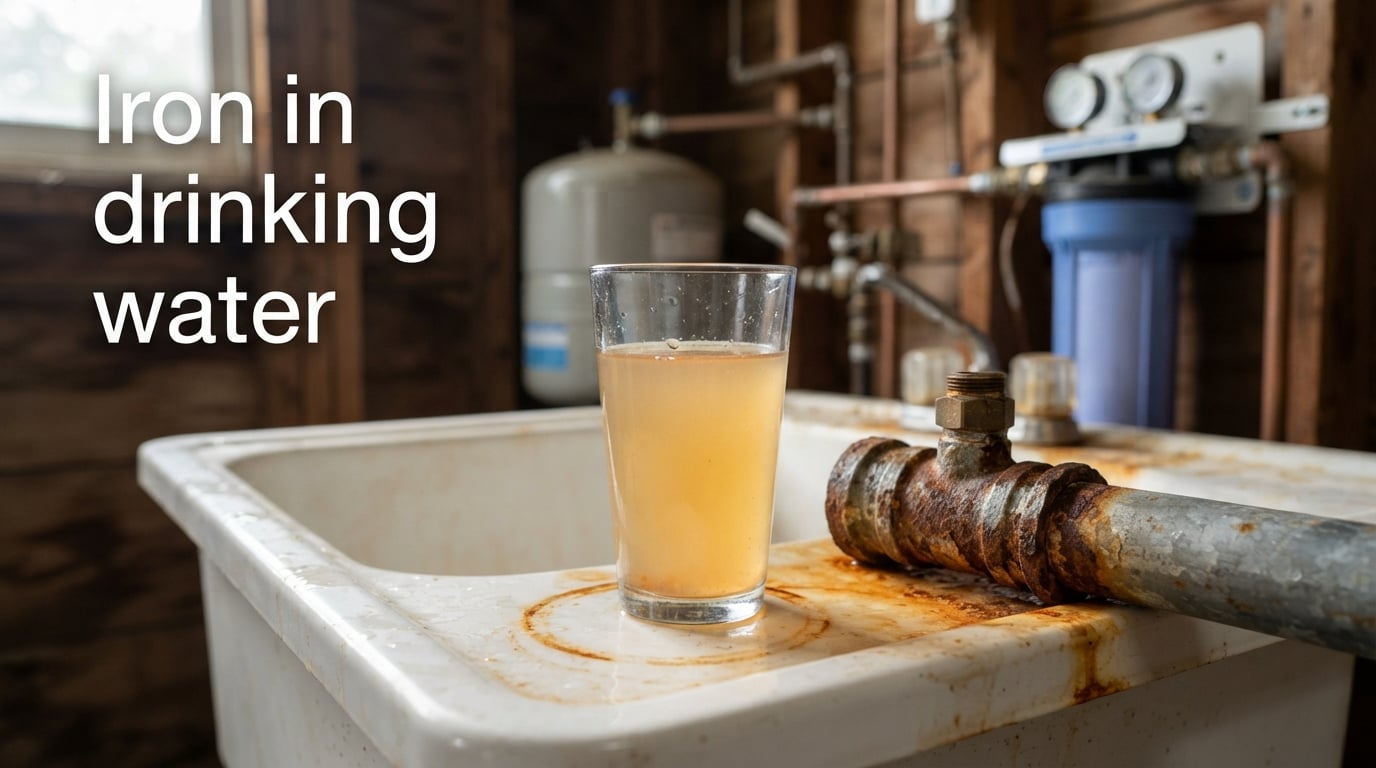
If you’ve ever poured a glass of water and noticed a metallic taste or rusty color, you’re not alone. Iron in drinking water affects an estimated 25 million Americans who rely on private wells, plus many homes connected to older municipal systems.
The good news is that it rarely makes you sick. The bad news is that it ruins plumbing, stains laundry, and turns everyday water use into a chore.
This guide walks you through what iron in drinking water really is, how it gets there, when it becomes a problem, and what you can actually do about it. We pulled the latest EPA guidance, state health department data, and real homeowner experiences to give you clear answers you can trust.
Table of Contents
What Is Iron in Drinking Water and Where Does It Come From
Iron in drinking water is a naturally occurring mineral that dissolves into groundwater as it passes through iron-rich rock and soil. It can also enter your tap from corroding iron pipes inside your home, especially in houses built before the 1960s.
The U.S. Geological Survey estimates that iron is present in measurable amounts in groundwater across most of the continental U.S. Regions with the highest natural iron levels include the Appalachian Mountains, the Upper Midwest, parts of New England, and the Southeast coastal plain.
If you live in these areas and rely on a private well, your water almost certainly contains some iron. Municipal water customers can have iron too, but it’s less common.
When iron shows up in city water, the source is usually corroding distribution mains, not the source water itself. Local water utilities are required to treat corrosion with additives like phosphate, but older infrastructure still bleeds iron into the system.
Two Main Sources of Iron in Tap Water
- Natural geology – iron-bearing minerals like pyrite and hematite release iron as groundwater moves through them.
- Corroding plumbing – galvanized iron pipes, old service lines, and water heaters with anode rods all contribute iron to your tap.
If you’re trying to figure out which one is causing your problem, run the cold tap for 30 seconds and collect a sample. Then run the hot tap.
If only hot water is discolored, your water heater or hot water lines are the likely culprit. If both taps show iron, it’s probably coming from the source water or your service line.
Ferrous vs Ferric Iron: Two Very Different Problems
Not all iron in water looks or behaves the same way. The two main forms are ferrous iron (Fe2+) and ferric iron (Fe3+), and figuring out which one you have determines the right treatment.
Ferrous Iron (Clear-Water Iron)
Ferrous iron is dissolved iron that stays invisible when it first comes out of the tap. The water looks perfectly clear.
Ferrous iron is unstable. As soon as it contacts air or chlorine, it oxidizes and turns into ferric iron, which then settles out as orange or brown particles. This is why your clear glass of water can develop a rust-colored ring after sitting on the counter for an hour.
Ferrous iron is most common in private wells with low dissolved oxygen. It often comes with a strong metallic taste, and it readily stains light-colored fixtures and laundry.
Ferric Iron (Red-Water Iron)
Ferric iron has already oxidized. It shows up immediately as rusty, yellow, or orange discoloration the moment you turn on the tap.
You can usually see it swirling in the water, especially after the water has been sitting in the pipes overnight. Ferric iron is what people commonly call “red water” or “rusty water.”
If your water looks discolored the instant you turn on the tap, you’re dealing with ferric iron. If it looks clear at first and stains later, it’s ferrous iron. This distinction matters because each type responds to different treatment methods.
How pH Affects Iron Behavior
Water pH controls how iron behaves in your plumbing. At pH below 7 (acidic), iron stays dissolved longer as ferrous iron. At pH above 7 (basic), iron oxidizes faster and precipitates as ferric particles.
Most groundwater sits between pH 6.5 and 8.5, which is right in the zone where iron behavior can shift dramatically based on small pH changes.
EPA Safety Level and Health Effects of Iron in Drinking Water
The EPA sets a Secondary Maximum Contaminant Level (SMCL) for iron at 0.3 mg/L, which equals 0.3 parts per million (PPM). A secondary standard is not a health-based limit. It’s an aesthetic guideline, meaning iron below this level usually doesn’t cause taste, staining, or odor issues.
For health, iron in drinking water is not considered dangerous at typical household levels. Most people would have to drink water with iron above 10 mg/L for years before experiencing any direct health effects, and concentrations that high are rare in U.S. water supplies.
Who Should Pay Closer Attention to Iron Levels
- People with hemochromatosis – this genetic condition causes iron overload. Medical guidance generally recommends keeping dietary iron intake low.
- Infants on formula – formula mixed with high-iron water increases total iron intake. Formula-fed infants are the most sensitive subgroup for iron exposure.
- Anyone noticing chronic gastrointestinal symptoms – if stomach upset, constipation, or unusual fatigue lines up with a move to a new water source, test your water.
The bigger concern with iron isn’t health, it’s the secondary damage: stained clothing, plugged pipes, ruined water heaters, and clogged appliance valves.
I toured one 1980s ranch home where the galvanized pipes had so much iron buildup that shower pressure had dropped to a trickle. Replacing the plumbing cost the homeowner $8,400, which would have been avoided with a $1,200 whole-house filter installed 10 years earlier.
How to Tell If You Have Iron in Your Water
Iron leaves clues around your house long before you ever think to test the water. Once you know what to look for, the signs are usually obvious.
Visual and Taste Clues
- Orange or brown stains on toilet bowls, sinks, tubs, and shower doors.
- Rust-colored streaks in white or light-colored laundry, especially after washing whites.
- Cloudy water that clears after sitting for a few minutes (ferric particles settling).
- Metallic taste, often described as biting a penny or sucking on a nail.
- Slimy orange or reddish-brown film in toilet tanks or on faucet aerators (this often means iron bacteria).
Iron vs Rust From Your Pipes
This is one of the most common questions on water forums. People want to know if they’re seeing iron from their source water or just rust flakes from old pipes.
- Source water iron – discolored water appears consistently across all faucets, including outdoor spigots fed directly from the well or service line.
- Pipe rust – discoloration appears only at certain faucets, gets worse after plumbing work, and clears up after running water for a minute.
If you’re still unsure, fill a clean white bucket from the outdoor spigot (bypass any softener or filter).
If the water is clear at the spigot but rusty in the kitchen, your interior plumbing is the problem. If it’s rusty at the spigot, the source water is contaminated.
When to Suspect Iron Bacteria
If your toilet tank looks like it has a stringy orange or rust-colored slime, you probably have iron bacteria. These microorganisms use iron as an energy source and produce a slimy biofilm that can plug pipes and fixtures.
Iron bacteria are not a health threat, but they accelerate corrosion and make iron stains much harder to remove.
Testing Your Water for Iron
You don’t need to guess. Testing is fast, cheap, and tells you exactly what you’re dealing with.
DIY Test Kits
Home iron test kits run between $15 and $40 and give results in under 10 minutes. Most use color-changing test strips that compare against a PPM chart.
They’re accurate enough for screening but not for official documentation.
Professional Lab Testing
A state-certified water test typically costs $25 to $150 depending on your state and how many contaminants you screen for. We recommend ordering a basic iron, manganese, pH, and hardness panel if you have a private well.
Your state health department or county extension office can recommend a certified lab. Results usually come back within 5 to 10 business days.
What Levels Mean
- Below 0.3 mg/L – generally not noticeable; no treatment needed.
- 0.3 to 1.0 mg/L – mild staining and taste; treatment recommended if stains bother you.
- 1.0 to 5.0 mg/L – obvious staining, strong taste; treatment strongly recommended.
- Above 5.0 mg/L – severe staining, plumbing damage likely; whole-house treatment required.
Test your water at least once a year if you have a private well. Levels can shift as the water table changes seasonally, especially after heavy rain or drought.
Treatment Options by Iron Type
The right treatment depends on which form of iron you have, how much there is, and whether iron bacteria are present. Here’s how the most common methods stack up.
Oxidation Filtration
Oxidation filters convert dissolved ferrous iron into solid ferric particles, then trap those particles in a filter media bed. They work well for iron levels up to about 10 mg/L and don’t require electricity.
The filter media typically needs to be backwashed every few days and replaced every 5 to 10 years.
Water Softeners
Standard salt-based water softeners can remove small amounts of ferrous iron, generally up to about 1 to 2 mg/L. They won’t work on ferric iron, and iron above 3 mg/L will foul the resin and shorten softener life.
If you already have a softener and your iron is mild, this can be a low-cost add-on. If your iron is high, a softener alone won’t cut it.
Reverse Osmosis (RO)
Point-of-use RO systems under your kitchen sink remove nearly all iron along with other contaminants. They’re great for drinking and cooking water but don’t treat your shower or laundry water.
We recommend RO as a polishing step after whole-house treatment, not as your primary defense.
Chlorination and Greensand Filters
For high iron levels or iron bacteria, professionals often inject chlorine into the water before it reaches a greensand filter. Chlorine oxidizes iron and kills bacteria, while greensand traps the particles.
This combination handles iron up to about 15 mg/L and is the standard treatment for iron bacteria problems.
Cost Comparison of Common Iron Treatment Methods
- Whole-house oxidizing filter: $1,200 to $3,000 installed; $100 to $200 per year in media and maintenance.
- Chlorine injection + greensand filter: $2,500 to $5,000 installed; $200 to $400 per year.
- Salt-based softener (for low iron only): $800 to $2,000 installed; $150 to $300 per year in salt.
- Point-of-use RO system: $300 to $800 installed; $75 to $150 per year in filters.
- Whole-house RO system: $6,000 to $12,000 installed; $400 to $800 per year in maintenance.
For most homeowners with iron between 0.3 and 3.0 mg/L, a whole-house oxidizing filter hits the sweet spot between cost and performance. For higher levels or iron bacteria, the chlorine and greensand system pays for itself in avoided plumbing repairs.
Iron Bacteria: The Hidden Issue in Well Water
Iron bacteria are naturally occurring microorganisms that oxidize iron as part of their metabolism. They don’t cause disease, but they create three real problems: slimy orange biofilms in toilet tanks and pipes, accelerated corrosion of metal plumbing, and persistent staining that’s hard to remove even with treatment.
Identifying Iron Bacteria
The clearest sign is a slimy, rust-colored film in your toilet tank. Lift the lid and look at the waterline.
If you see orange-brown streaks or a gelatinous film that comes off on your finger, iron bacteria are likely present. A lab test can confirm by culturing the sample, but most homeowners can identify it visually.
Treating Iron Bacteria
Shock chlorination is the standard first step. This involves pouring a high concentration of chlorine into the well, running it through every fixture, and letting it sit for 12 to 24 hours before flushing the system.
Many well drillers offer this service for $300 to $600. Shock chlorination kills existing bacteria but doesn’t prevent regrowth, so it’s often paired with continuous chlorination injection and a carbon filter.
How to Prevent Iron Problems Before They Start
Prevention is cheaper than repair, especially when it comes to plumbing.
- Test your well water annually – iron levels rise and fall with groundwater conditions. Annual testing catches problems before they stain your house.
- Inspect exposed plumbing – if you have galvanized pipes older than 40 years, budget for replacement. They’re corroding from the inside out.
- Install a whole-house filter at the point of entry – this protects every fixture and appliance, not just your drinking water.
- Flush your water heater yearly – sediment that includes iron settles in the tank and feeds iron bacteria growth.
- Replace anode rods proactively – if you have a smelly or rusty water heater, the anode rod may be the source.
If you’re on a private well and have never tested your water, this is your sign. A $30 test strip today can save you thousands in plumbing repairs tomorrow.
Frequently Asked Questions About Iron in Drinking Water
What is a safe iron level in drinking water?
The EPA sets a Secondary Maximum Contaminant Level of 0.3 mg/L (0.3 PPM) for iron in drinking water. This is an aesthetic guideline, not a health limit. Below 0.3 mg/L, most people won’t notice iron. Health effects are uncommon below 10 mg/L.
What are the side effects of iron in drinking water?
At typical household levels, iron in drinking water causes aesthetic side effects: metallic taste, orange or brown stains on fixtures and laundry, cloudy water, and foul odor. It can promote iron bacteria growth, which clogs pipes and corrodes plumbing. Direct health effects are rare below 10 mg/L, but people with hemochromatosis should consult their doctor about iron intake from all sources.
How do I remove iron from drinking water?
The best treatment depends on your iron type and concentration. For ferrous (clear-water) iron up to 10 mg/L, an oxidizing filter works well. For ferric (red-water) iron, filtration after oxidation is the standard. For iron above 10 mg/L or iron bacteria, inject chlorine before a greensand filter. Point-of-use reverse osmosis can polish drinking water but won’t treat the whole house.
Will a Brita or pitcher filter remove iron from water?
Standard pitcher filters like Brita are not designed to remove iron. They reduce chlorine taste and some contaminants but leave dissolved iron in the water. To remove iron with a pitcher filter, you’d need a model with a specific iron-removal cartridge, and even those handle only small amounts. For meaningful iron reduction, you need a dedicated oxidation filter, softener, or reverse osmosis system.
What causes iron in well water?
Iron in well water comes primarily from natural geology. As groundwater moves through iron-rich rock and soil, it dissolves the mineral and carries it into the well. Corroding iron pipes in older plumbing can also contribute iron to the water. Iron levels are highest in regions with iron-rich bedrock, including the Appalachian Mountains, the Midwest, and parts of New England.
Final Thoughts on Iron in Drinking Water
Iron in drinking water is one of the most common water quality issues in the U.S., and one of the easiest to diagnose and treat once you know what you’re dealing with. Start by figuring out whether you have ferrous or ferric iron, test your water through a certified lab, and match the treatment to your iron level.
For most homeowners, a whole-house oxidizing filter solves the problem without major expense. If you have a private well, make annual water testing a habit in 2026. Catching rising iron early protects your plumbing, your appliances, and your water’s taste for years to come.