
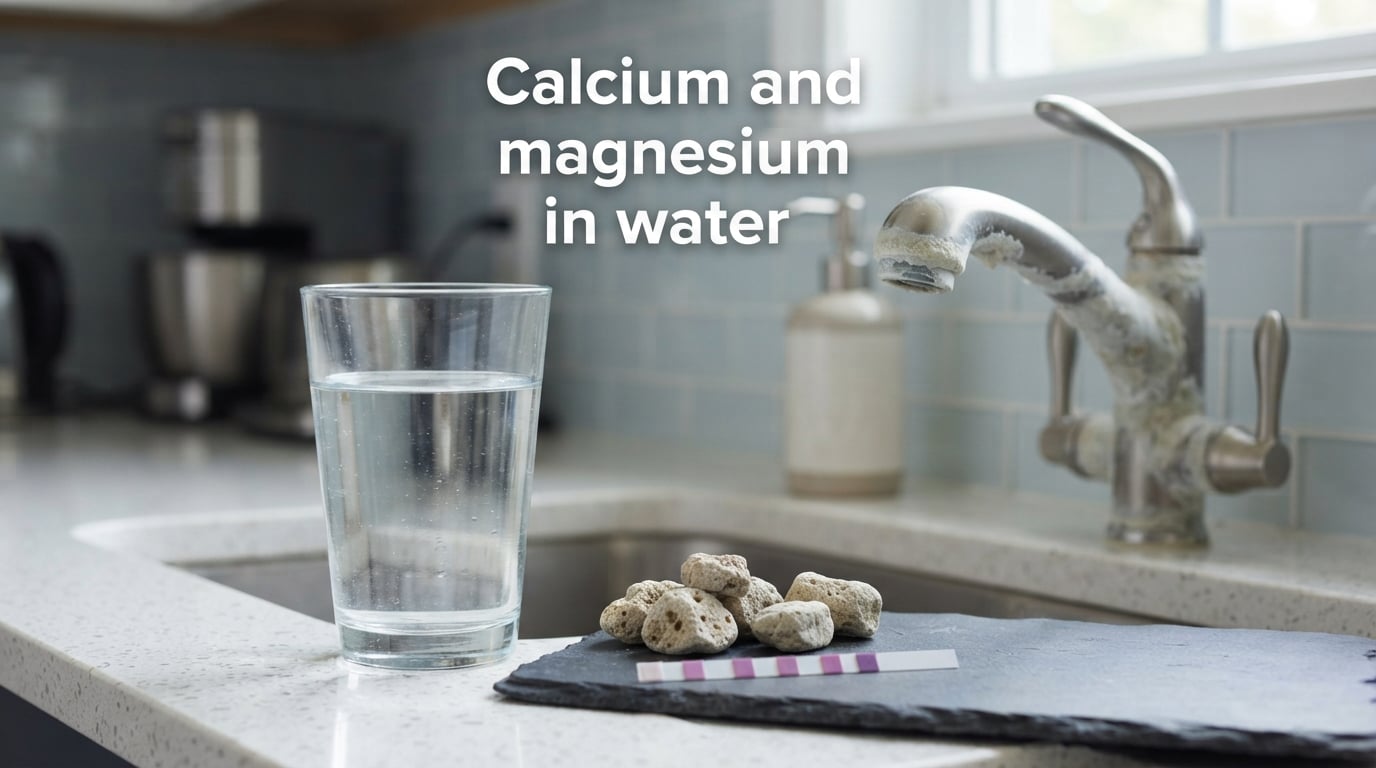
If you have ever noticed a white crust around your faucet or a film on your shower door, you are looking at calcium and magnesium in action. These two naturally occurring minerals are the primary drivers of what we call hard water, and they show up in nearly every glass of tap water in the country. Understanding calcium and magnesium in water matters because the levels directly affect your health, your home plumbing, and even how your soap performs.
I have spent the last few years researching water chemistry for MineralWaters.org, and one question comes up more than any other: are these minerals actually good for you, or should you be filtering them out? The answer is more nuanced than most filter companies would have you believe. Calcium and magnesium are essential nutrients that your body needs every single day, but at extremely high concentrations, they can cause real problems in your home.
This guide breaks down everything you need to know about calcium and magnesium in water. I will cover where these minerals come from, what they do to your body, how to measure them, and when you might want to consider reducing them. Whether you are on a private well or municipal water, this information will help you make smarter decisions about the water you drink.
Table of Contents
What Are Calcium and Magnesium in Water?
Calcium and magnesium in water are dissolved mineral ions that enter as groundwater moves through rock formations containing limestone, dolomite, and other carbonate-rich deposits. Together, these two minerals account for almost all of what scientists measure as total water hardness.
When geologists and water treatment professionals talk about hard water, they are specifically referring to the combined concentration of calcium ions (Ca2+) and magnesium ions (Mg2+) dissolved in the water supply. Calcium typically contributes more to total hardness than magnesium, though both play distinct roles in how your water behaves and tastes.
The term “hardness” goes back centuries. It originally referred to how difficult it was to get soap to lather in certain water supplies. The harder the water, the more soap it took to produce suds. That old definition still holds today, but we now understand the science behind it with far more precision.
Calcium vs. Magnesium: How They Differ
Calcium is usually the dominant hardness mineral in most water supplies, often accounting for 60 to 70 percent of total hardness. It dissolves readily from limestone and chalk deposits, making it especially common in regions with sedimentary geology. Magnesium tends to come from dolomite rock and contributes the remaining 30 to 40 percent in typical groundwater.
Both minerals carry a positive charge of plus two, which means they interact strongly with soap molecules and certain plumbing materials. That shared charge is why they behave similarly in your pipes and on your skin. But inside your body, calcium and magnesium serve different biological functions, which I will cover in the health section below.
Temporary vs. Permanent Hardness
Water hardness comes in two forms, and the distinction matters if you are thinking about treatment. Temporary hardness is caused by calcium and magnesium bicarbonates, which precipitate out as scale when you heat the water. This is the white buildup you see in kettles and on heating elements.
Permanent hardness comes from calcium and magnesium sulfates and chlorides, which remain dissolved even when water is boiled. Removing permanent hardness requires an ion exchange process rather than simple heating. Understanding which type dominates your water helps you choose the right treatment approach.
How Calcium and Magnesium Get Into Your Water
Calcium and magnesium enter water supplies primarily through a natural geological process: rainwater absorbs carbon dioxide from the atmosphere to form weak carbonic acid, which then dissolves calcium and magnesium compounds as it percolates through mineral-rich rock layers. This process takes place over decades or even centuries underground.
Limestone is the most common source of calcium in water. It is primarily calcium carbonate, and it dissolves slowly when exposed to slightly acidic water. Dolomite rock, which contains both calcium and magnesium carbonates, contributes the magnesium fraction. Regions with abundant limestone and dolomite, like parts of Texas, Florida, and the Midwest United States, tend to have some of the hardest water in the country.
If you want to taste what high mineral content water is really like, high mineral content waters like Contrex offer a vivid example. These naturally mineralized waters come from deep aquifers that have spent extended contact time with mineral deposits, picking up calcium and magnesium levels far above what you find in typical tap water.
Groundwater vs. Surface Water Sources
Groundwater tends to be significantly harder than surface water because it has more contact time with underground rock formations. A municipal system drawing from a deep aquifer will almost always deliver harder water than one pulling from a river or lake.
Surface water sources like rivers and reservoirs pick up far fewer dissolved minerals because the water spends less time in contact with rock. Cities supplied by surface water often have moderately soft water, while communities relying on wells and aquifers deal with moderate to very hard water.
Private wells deserve special mention here. Well water can vary dramatically even between neighboring properties, depending on the specific geology each well taps into. The North Carolina Department of Health documented calcium levels ranging from 1 to 400 mg/L and magnesium levels from 1 to 600 mg/L across private wells statewide.
Health Benefits of Calcium and Magnesium in Drinking Water
Calcium and magnesium in drinking water provide real, measurable health benefits because both are essential minerals your body needs for bone structure, nerve signaling, muscle contraction, and hundreds of enzymatic reactions. Studies have generally found that hard water has positive effects on the health of people who drink it regularly.
The most compelling research comes from large epidemiological studies examining cardiovascular health. A peer-reviewed study published in the National Library of Medicine found that drinking water with high concentrations of calcium and magnesium, particularly magnesium, may lower the risk of stroke in postmenopausal women. The protective effect appeared to be dose-dependent, meaning higher mineral concentrations correlated with better outcomes.
What makes this research particularly interesting is that minerals dissolved in water may be more bioavailable than those from food or supplements. Your body can absorb calcium and magnesium directly from water without requiring the digestive breakdown that solid foods demand.
Calcium’s Role in Your Body
Calcium is the most abundant mineral in the human body, and about 99 percent of it lives in your bones and teeth. The remaining one percent circulates in your blood and plays a part in blood clotting, nerve transmission, and muscle contraction. Getting enough calcium daily is non-negotiable for long-term skeletal health.
Drinking water can contribute meaningfully to your calcium intake. A glass of moderately hard water containing 100 mg/L of calcium provides about 10 percent of the recommended daily intake for an adult. Over the course of a day, water alone can supply a significant fraction of your calcium needs.
Magnesium’s Role in Your Body
Magnesium is involved in over 300 enzymatic reactions in the human body. It helps regulate muscle and nerve function, blood sugar levels, and blood pressure. It also supports the production of protein, bone tissue, and DNA. Despite its importance, an estimated half of adults in developed countries consume less magnesium than they should.
This is where hard water becomes a genuine health asset. Water with adequate magnesium levels provides a steady, low-dose source of this critical mineral throughout the day. If you want to understand how mineral content in water supports overall hydration and nutrition, the same principle applies: dissolved minerals are working in your favor.
What the Studies Show About Hard Water and Health
The McGill Office for Science and Society, a respected source for evidence-based health information, reviewed the scientific literature on hard water and concluded that studies have generally found hard water to have positive effects on the health of its drinkers. This runs counter to the marketing messages from many water softener companies that frame hardness as a problem to be eliminated.
Research published by the National Institutes of Health points to a dose-dependent protective effect against cardiovascular disease in populations consuming harder water. The mechanism is not fully understood, but researchers believe the regular intake of calcium and magnesium from drinking water helps maintain healthy blood vessel function over time.
Importantly, the research does not suggest that hard water causes kidney stones, a common myth. The McGill review specifically addressed this concern and found no credible evidence linking normal hard water consumption to increased kidney stone formation. Dietary factors and genetics play a far larger role in stone formation than water hardness.
Water Hardness Scale: Measuring mg/L and ppm
Water hardness is measured in milligrams per liter (mg/L) of calcium carbonate equivalent, which is the same as parts per million (ppm). This single number tells you the combined contribution of both calcium and magnesium, expressed as if all the hardness came from calcium carbonate alone.
Most laboratories and water authorities use a four-tier classification system to describe hardness levels. Here is the breakdown you will typically see:
Soft water: 0 to 60 mg/L (0 to 60 ppm) – Minimal calcium and magnesium, easy on appliances, may taste flat
Moderately hard water: 61 to 120 mg/L (61 to 120 ppm) – Balanced mineral content, generally pleasant to drink
Hard water: 121 to 180 mg/L (121 to 180 ppm) – Noticeable scale formation, good mineral intake
Very hard water: Over 180 mg/L (over 180 ppm) – Significant scale buildup, strong mineral taste, may warrant treatment
These ranges come from the United States Geological Survey and are widely used by water treatment professionals. The World Health Organization has stated that hardness levels up to 500 mg/L are generally acceptable for drinking, though most people start to find the taste unpleasant well before that point.
Understanding the Calcium to Magnesium Ratio
Total hardness tells you the combined mineral load, but the ratio of calcium to magnesium also matters for specific applications. In most natural waters, calcium dominates by a ratio of roughly two to one or three to one.
Coffee enthusiasts and home brewers on forums like Reddit regularly discuss optimal calcium-to-magnesium ratios for extraction and flavor. A common recommendation for brewing falls between two-to-one and four-to-one calcium to magnesium. Gardeners pay attention to the same ratio because excessive magnesium relative to calcium can interfere with plant nutrient uptake.
For everyday drinking, the natural ratio in your water is perfectly fine. The ratio question becomes important when you are remineralizing water with calcium and magnesium after reverse osmosis filtration, where you control exactly what goes back in.
How Calcium and Magnesium Affect Your Home
Calcium and magnesium affect your home by forming scale deposits inside pipes, on heating elements, and on fixtures whenever water is heated or evaporates. This scale reduces appliance efficiency, shortens equipment lifespan, and creates the stubborn white residue that is so difficult to clean from shower doors and faucets.
The scale forms because heating causes dissolved calcium and magnesium bicarbonates to precipitate out of solution as solid carbonates. This is why your kettle, dishwasher heating element, and water heater accumulate buildup fastest. Each millimeter of scale acts as insulation, forcing your heating elements to work harder and use more energy.
Soap and Detergent Performance
Hard water significantly reduces soap effectiveness because calcium and magnesium ions bind with soap molecules to form an insoluble scum instead of the lather you want. This is the original meaning of the word “hard” in hard water: it is hard to get soap to work.
In practical terms, this means you need more detergent to achieve the same cleaning results with hard water. Laundry washed in very hard water can come out feeling stiff and looking dingy over time. Dishes may develop water spots. And your shampoo may leave a residue that makes hair feel dull and heavy, which is why some people notice dramatic improvements when they visit areas with softer water.
Skin and Hair Effects
Many people report that hard water leaves their skin feeling dry and their hair feeling coarse. The mineral residue left on skin after washing can disrupt the natural moisture barrier, potentially aggravating conditions like eczema in sensitive individuals. The magnesium and calcium soap scum is the main culprit.
Some users in online water treatment communities report that switching to filtered or softened water noticeably improved their skin and hair within weeks. Others point out that the minerals themselves are not harmful topically; the issue is the soap residue they create. If you are exploring whether filtration might help, understanding Brita filters and mineral retention is a good starting point, since not all filtration methods strip out beneficial minerals.
Cooking With Hard Water
Hard water can subtly affect cooking results in ways most people never notice. The calcium and magnesium can alter the texture of dough, change the extraction profile of coffee and tea, and even affect how vegetables soften during boiling.
Home brewers and coffee enthusiasts are the most attuned to these effects. The Specialty Coffee Association recommends specific total dissolved solids ranges for optimal extraction, and calcium plays a direct role in how flavor compounds pull from coffee grounds into your cup. This is why the same beans can taste different depending on the water you use.
For everyday cooking, moderately hard water is perfectly fine and may even improve flavor by adding trace minerals. The effects become more noticeable only at extreme hardness levels, where the mineral taste can overpower delicate flavors.
How to Test Calcium and Magnesium Levels in Your Water
You can test calcium and magnesium levels in your water using three main methods: home test strips for quick estimates, liquid titration kits for more accuracy, and professional laboratory analysis for the most detailed and reliable results. The right choice depends on how precise you need the numbers to be.
Home Test Strips
Hardness test strips are the simplest and cheapest option. You dip the strip into a sample of your water, wait a few seconds, and compare the color change to a reference chart. These strips typically give you a range rather than a precise number, but they are good enough to tell you whether you fall into the soft, moderate, hard, or very hard category.
The downside of test strips is accuracy. They can be affected by water temperature, how long you leave the strip submerged, and how fresh the strip is. Treat the results as a rough guide, not a definitive measurement.
Liquid Titration Test Kits
Liquid titration kits work by adding a chemical solution drop by drop to a water sample until a color change indicates the hardness level. You count the drops to calculate the mg/L value. These kits are more accurate than strips and are the standard tool used by aquarium hobbyists and pool owners who need reliable hardness readings.
The main limitation is that titration kits measure total hardness only. They will not tell you the individual contributions of calcium versus magnesium. For that breakdown, you need a more advanced test or a laboratory report.
Professional Laboratory Testing
Sending a water sample to a certified laboratory gives you the most complete picture. A standard water analysis will report calcium and magnesium separately, along with other minerals, total dissolved solids, pH, and potential contaminants. This is the best option if you are on a private well or considering a major investment in water treatment equipment.
Many county health departments offer free or low-cost well water testing. If you use a private lab, expect results within one to two weeks. Keep your lab report on file so you can compare results over time and catch any changes in your water quality.
Forum users on Reddit consistently recommend professional lab testing over home kits for anyone making decisions about water treatment. The small cost difference is worth it when you are choosing between a water softener, a conditioner, or no treatment at all.
When Should You Remove Calcium and Magnesium From Water?
Removing calcium and magnesium from water makes sense when hardness exceeds approximately 180 mg/L and you are experiencing significant scale buildup, appliance damage, or persistent skin and hair issues. Below that threshold, the health benefits of these minerals generally outweigh the inconvenience of moderate hardness.
The most common removal method is ion exchange, the process used in traditional water softeners. These systems replace calcium and magnesium ions with sodium or potassium ions, effectively eliminating hardness. They are effective but add sodium to your water, which may be a concern for people on sodium-restricted diets.
Water conditioners and descalers offer an alternative that does not actually remove the minerals but changes how they behave, reducing scale formation without adding sodium. These systems are less effective for extreme hardness but appeal to people who want to retain the minerals for health reasons while reducing their impact on plumbing.
It is worth repeating that from a pure health standpoint, calcium and magnesium in drinking water are beneficial. The decision to remove them should be driven by practical household concerns, not by fear that they are dangerous. The research consistently shows the opposite.
Frequently Asked Questions
Is it good to have calcium and magnesium in water?
Yes, calcium and magnesium in water are beneficial for most people. Both are essential minerals your body needs for bone health, nerve function, and muscle operation. Studies show hard water has a dose-dependent protective effect against cardiovascular disease.
How much calcium and magnesium should be in drinking water?
Ideal calcium and magnesium levels fall between 60 and 120 mg/L total hardness for balanced taste and health benefits. The WHO considers levels up to 500 mg/L acceptable for drinking, though taste becomes unpleasant well below that threshold.
What happens when calcium and magnesium react with water?
Calcium and magnesium dissolve into water as positively charged ions rather than chemically reacting with it. When heated, their bicarbonate forms precipitate as solid calcium and magnesium carbonate, creating the scale buildup you see in kettles and pipes.
Why would you want to remove calcium and magnesium from water?
Removal makes sense when hardness exceeds 180 mg/L and causes significant scale buildup, appliance damage, reduced soap effectiveness, or skin and hair irritation. Ion exchange water softeners are the most common removal method.
The Bottom Line on Calcium and Magnesium in Water
Calcium and magnesium in water are essential minerals that your body actually needs, not contaminants to fear. They enter groundwater naturally through limestone and dolomite deposits, they support bone health and cardiovascular function, and they are generally safe to drink at any realistic concentration.
The practical concern is household scale buildup, not health risk. If your water hardness exceeds about 180 mg/L and you are dealing with appliance damage, soap problems, or skin irritation, treatment options like ion exchange softeners or salt-free conditioners can help. Below that level, you are likely better off leaving the minerals in and enjoying the nutritional benefits.
The smartest first step is always to test your water so you know exactly what you are working with. Once you have real numbers, you can decide whether any treatment is worth the investment or whether your water is already in a healthy, drinkable range.